Probably everyone knows someone who wears barefoot shoes, and maybe that person has already tried to convince you to try them.
There's currently a real hype surrounding these thin-soled shoes, also known as minimalist shoes.
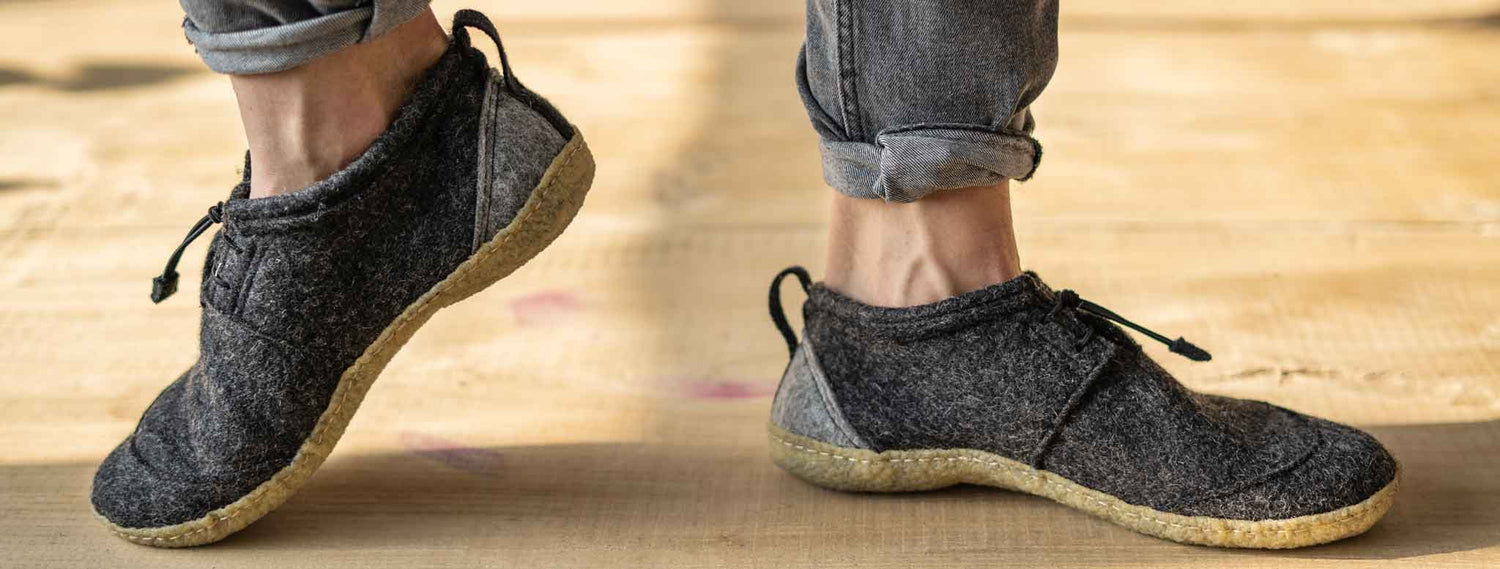
With our WoolFit brand, we have developed various shoe models that combine the advantages of barefoot shoes with the comfort of a slipper. In other words, barefoot slippers.
In this blog post, you will learn in 5 minutes:
- what makes a barefoot shoe
- what are the advantages and potential problems
- and which WoolFit barefoot slippers are the right choice for you.

1. What makes a barefoot shoe?
- Foot-friendly shape and wide toe box:
With conventional shoes, the toes are often forced into an unnatural shape by the "fashionable" slender design. Barefoot (house) shoes can help restore the natural toe splay of the feet over time.
If you're looking for a barefoot slipper with a particularly spacious toe box, we recommend our WoolFit Footprint barefoot slipper, which has the widest toe box of all our models. But our other shoes also do not constrict the feet in any way and give way a little due to the natural felt material.
- Flexible material:
To allow for a natural rolling motion of the foot, it is important that both the sole and the upper material of the shoe can easily bend with it.
Here, the more flexible, the easier it is, even mentally, to perform a natural walking movement.
For felt barefoot shoes, it is important that the felt is not too hard. All WoolFit models are suitable for this, except our Classic series, as the hand-felted shaft is mechanically hardened again.

- Very thin sole: The thinner the sole, the more you feel of your surroundings. Our feet are actually just as sensitive as our hands. A particularly thin sole helps our feet learn to feel properly again.
Our WoolFit Nomad is a barefoot shoe-slipper hybrid with a thin natural rubber sole, allowing you to feel every bump and pebble.
Our Footprint barefoot slipper, on the other hand, has a thick felt layer, so you might not feel everything, but you'll feel incredibly comfortable! Like walking barefoot - but soft and warm.

If you want to particularly train your foot's sensory perception, we recommend our WoolFit FeelGood Footbed, which simulates walking on uneven ground with its small felt spheres. We have also received feedback from customers with neurological problems in their feet (nerve damage) who experienced significant improvement with the footbed.

- Zero-drop: conventional shoes have a raised heel area, which is supposed to provide special impact absorption. This disrupts the body's balance. Because it tries to compensate for the increased angle by leaning back slightly, which affects your posture and gait.
Many people have become so accustomed to such a heel that they feel uncomfortable when it's absent. For this reason, our WoolFit Classic series also has a very slight heel (0.5cm).
For those who want a zero-drop, we recommend the WoolFit Nomad barefoot shoe (suitable for outdoors), the WoolFit Footprint or the WoolFit Tibet.
- Minimal arch support: barefoot walking is supposed to strengthen the foot muscles, so that the foot is naturally healthier and does not need additional support.
Our WoolFits feature a lightly supportive felt footbed. This provides a footbed feeling without "taking the work away" from the foot, as it is so soft and flexible that the foot is still sufficiently challenged.
2. What are the advantages of barefoot shoes or slippers?
- Strengthening or regeneration of foot muscles & prevention of deformities:
For many people whose feet may have been forced into an unnatural position for decades by overly tight, rigid footwear, the foot muscles have now atrophied. When walking barefoot, however, the foot muscles are properly challenged again and used to cushion your body weight, for which they are actually perfectly aligned after millions of years of evolutionary development. This natural, intended use of the foot muscles actively prevents foot deformities, which are otherwise rather promoted by overly tight footwear.
- Stabilization of ankle joints and strengthening of tendons & ligaments:
Similarly, the tendon system in your soles is specifically used when walking barefoot. Along with the strengthening of the muscles, the many tendons & ligaments that hold your foot together are also strengthened. In addition, the ankle joints are stabilized, making you less prone to sprains, even on adverse & uneven ground, as the entire musculoskeletal system of your feet is strengthened. As a result, after some time, you will notice that you are simply more light-footed & agile and genuinely enjoy running & walking.
- Promotion of balance, fine motor skills & overall body balance:
When walking barefoot, the nerves in your soles are in active communication with your brain, as unevenness or sharp objects must be reacted to immediately by dodging or adjusting your posture. Therefore, regular barefoot walking & the conscious perception of different floor surfaces also sharpen your sense of balance, your reflexes & your fine motor skills.
- Your feet's circulation is stimulated:
Since the foot muscles are actively engaged when walking barefoot, blood circulation to the feet is also automatically stimulated. The increased blood flow generates natural body heat. This also prevents your feet from getting cold when walking on cold stone floors or tiles, despite the very thin soles typical of barefoot shoes. Our Footprint barefoot slipper also has a nice thick felt sole that insulates excellently – so you're guaranteed not to get cold feet, even when you're not moving.
- The perception of different surfaces through highly sensitive soles is a true sensory experience & reduces stress:
Perhaps you remember the feeling of exploring the landscape barefoot as a child on different surfaces like soft moss or sand. Even gravel paths, which many people might initially consider adverse, can be very pleasant & exciting to walk on with healthy feet without artificially hardened calluses (or in barefoot shoes). Because human feet are fundamentally as sensitive & sensory as our hands are, and are simply not made to be "imprisoned" in shoes all day, where they constantly have to rest on the same footbed. Walking on different surfaces can even have a truly therapeutic effect and help to relax and reduce stress after a strenuous day. You can try it out for yourself, for example, by simply walking barefoot on the lawn in your garden for 5 minutes after getting up in the morning or before going to bed in the evening.
- Promotion of holistic healthy posture & alleviation of joint, knee, back & neck pain:
Healthy feet used for natural walking are the basis for correct posture and thus the cornerstone of holistic physical well-being. An unnatural foot position makes the entire body more susceptible to joint problems, back pain, neck tension, and even headaches up to jaw problems. The zero drop, which is typical for barefoot shoes, puts your feet in a natural position. This makes it easier to correctly straighten the spine when walking and to bring the pelvis into a natural position, allowing the back to recover.
3. Is barefoot walking suitable for everyone? What potential problems can arise?
- Worsening of existing foot complaints:
Many feet have unfortunately reached a point where the use of an orthopedic insole may be the more sensible approach. This is because with existing deformities, barefoot walking can actually lead to their further development due to overuse of the foot muscles. Our WoolFit Classics with insoles offer sufficient space for most insoles. For a particularly secure fit of the insoles, we recommend the closed slipper model.
Therefore, you should clarify whether barefoot walking is suitable for you with your podiatrist or physiotherapist beforehand.
- Initial muscle soreness:
Since the foot muscles, which are usually significantly atrophied, are challenged again for the first time in a long time when walking barefoot, it is not uncommon to experience muscle soreness in the feet at the beginning. However, this is a positive signal that the foot muscles are being properly challenged again as desired and can consequently regenerate and rebuild.
- Initially increased perspiration:
In conjunction with the previous point, it can also happen that the feet start to sweat more during the adjustment period, especially in warm outdoor temperatures, due to increased exertion & blood circulation. However, experience shows that this phenomenon subsides after a short acclimatization period. Furthermore, sweating is fundamentally not a bad thing, but a vital bodily function. Problems usually only arise when sweat cannot escape due to synthetic upper materials and accumulates in shoes or slippers. Since high breathability is a fundamental advantage of our felt slippers, they are ideally suited as an introduction to barefoot walking, as the increased perspiration is actively counteracted by the upper material. Excess moisture and heat are quickly absorbed by the felt and then released into the air.
4. Which WoolFit barefoot slippers are right for me?
- For beginners who want a light, cozy barefoot feeling:
Our WoolFit Footprint barefoot slipper has a thick, firmly integrated felt footbed, but this is so soft & flexible (just like the outer leather sole) that the foot muscles still have to actively work when walking, creating a barefoot feeling. The model also features a zero drop and a fairly wide toe box. Due to the particularly soft & flexible felt, the Footprint hardly restricts the feet when walking and also comfortably gives way if necessary.
- For purists or experienced barefoot walkers:
The WoolFit Nomad barefoot shoe is our first true barefoot shoe in the classic sense, as it has no footbed and an extremely thin and non-slip natural rubber sole. We have since made the sole 50% thicker for longer durability, which only minimally reduces the sensation of the ground.
Our Taiga model also now has a zero drop.
- Suitable for your own (orthopedic) insoles:
Both our Taiga model and the Nomad have enough space for a thin insole. For thicker orthopedic insoles, we definitely recommend the Classic Pantoffel or Classic Slipper model.
Thanks for reading! If you have any questions, just send us an email or contact us via social media.
Always stay cozy,
Your Benni from WoolFit