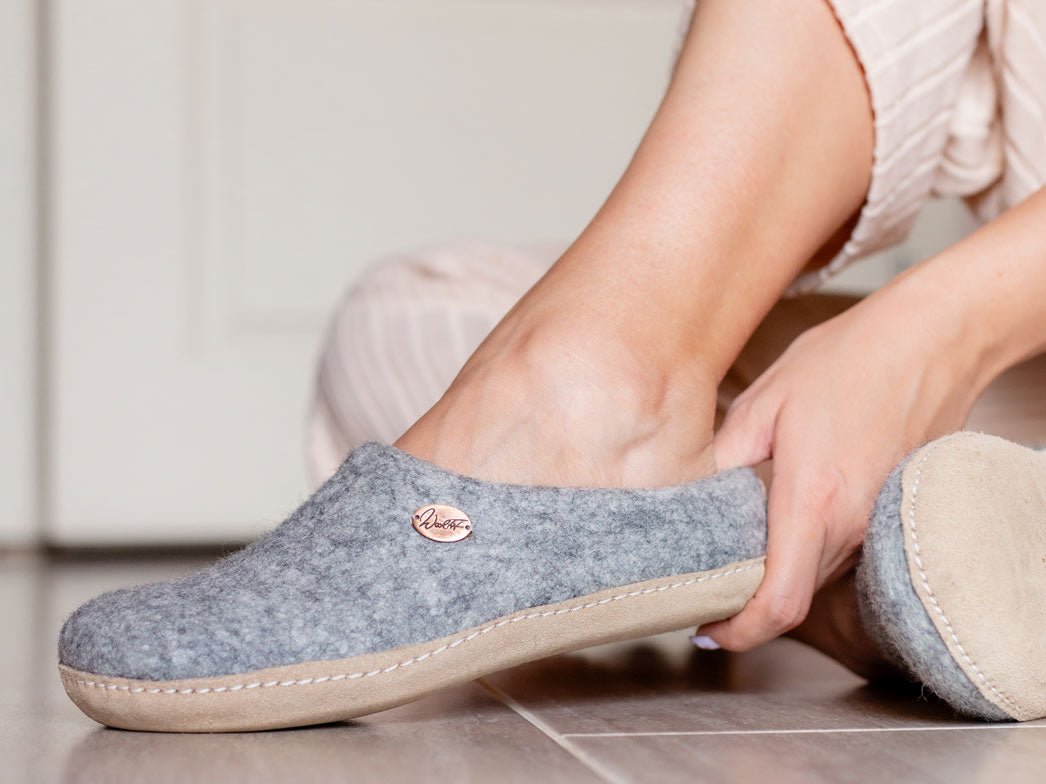

It may sound far-fetched, but warm slippers can actually save a lot on heating costs. Especially in the current crisis, where energy prices have been driven up by the terrible war in Ukraine, we are all asking ourselves what we can do to save energy and money.
In addition to gasoline and diesel prices, heating is another expensive factor directly dependent on fossil fuel prices for energy consumption. But fortunately, more than 10% of heating costs can be saved in the short term if we set the room temperature lower. This does not involve major restrictions, provided we ensure our comfort in other ways. This is where warm slippers come in. Cozy slippers made of natural wool felt make even cooler rooms comfortable.
Save heating costs and help the environment - kill two birds with one slipper!
Heating is expensive and bad for the environment. For a long time, it has been important to us to reduce our negative impact on nature and the climate. Sustainability is a way of life. That's why we avoid unnecessary consumption of raw materials not only in our products. It is important that we not only pay attention to the financial costs of heating but also include the impact on our climate footprint.
It has long been clear that Germany must reduce its consumption of fossil fuels for heating if it wants to achieve its climate targets. On average, the consumption of gas and heating oil contributes almost 15% to the CO₂ footprint of every German: almost 1.3 tons of carbon dioxide per year, which is more than meat consumption (1 ton) and almost as much as transport by car, plane, bus and train (2 tons).
Quite drastic, and yet heating often takes a back seat in discussions about sustainable lifestyles. Often, it would be enough to regulate the room temperature a little more consciously.
So, put your feet in our warm felt slippers and turn down the heating a bit - and your CO₂ footprint will already be a little lighter.
How much can really be saved on heating costs?
The good news is that we all have a certain degree of control over heating, and can thus do our part. This is even much easier than with transport, where an electric car or switching to a bicycle involves high costs or an extreme lifestyle change.
It doesn't require a large investment in a heat pump or new heating, because even just by turning a thermostat, consumption can be directly influenced. Whether you're a tenant or a homeowner, it always pays off financially. The climate will thank you, and even with small measures like warm felt slippers, a lack of comfort can be avoided.
As with many things, the first important step is awareness. Simply turning up the heating until you're cozy and warm is rarely the right choice. And depending on the heating system and room, we heat all day, only to be unable to sleep at night because the air is too stuffy.
Every degree of room temperature can mean up to 6% more energy consumption.
Two or three degrees warmer or colder in the apartment makes a huge difference in consumption and costs. The heating costs for a single-family house with an area of 110 m² when heated with gas can quickly exceed 1000 euros per year. Those who can manage with a slightly lower room temperature can quickly save several hundred euros here.
And especially since working from home has become much more widespread, we spend more time at home and our heating costs tend to go up.
The right temperature for each room is the decisive factor in saving heating costs!
In the bedroom, cooler air helps. 17 degrees is sufficient here and even conducive to a restful sleep. A low temperature is also suitable in the kitchen, as we remain active while cooking and the stove and oven radiate heat.
Speaking of the kitchen: after a frosty day in the fresh air, a hot winter soup or aromatic tea helps to quickly warm us up again.
Bathrooms and living rooms or studies, on the other hand, can tolerate a slightly higher temperature, as we spend a lot of quiet time here. Whether 20 degrees or 22 degrees depends on personal preference, but you can strongly influence this too and thus squeeze out some extra savings.
Insulate your body with warm slippers and save on heating costs - here's how!
The larger the room that needs to be heated, the more energy has to be used to make its occupants feel comfortable. And the worse the insulation of the apartment, the more energy is lost.
That's why we diligently insulate our houses and apartments. But that doesn't help much if we then sit barefoot or in a T-shirt in front of the heater.
We have long realized that our heating bill is drastically reduced if we first insulate ourselves with appropriate clothing. A sweater is quickly put on. If you like it even warmer, opt for a wool poncho.
But even more important is to pay attention to your feet. They are extremely important for our temperature perception. So, warm slippers directly help you to lower your heating costs!
Why are warm feet so important for our temperature perception?
At least our mothers always warned us about cold feet: "Put on thick socks, otherwise you'll catch a cold!" was a warning heard daily in winter.
Even though we often rebelled and ignored it, our mothers were right. Because our feet are incredibly important for our perception of cold, and there are several reasons for this.
Air is a poor conductor of heat, whereas cool floors transfer cold directly. Especially modern floor coverings are often made of cool materials like stone or ceramic, which amplifies the effect. Wooden floors and carpeted floors, which have gone out of fashion, are better suited in terms of their thermal properties. So the rule is:
The cooler the floor covering, the more cozy wool slippers contribute to the feeling of warmth. The heating doesn't have to be turned up as much!
In extreme cases, we all know it from the Christmas market: even large amounts of warm drinks don't help against the frost if we wear thin socks or inappropriate shoes.
But why do we feel the cold in our feet so extremely? As soon as our body notices that the environment is a little too cool for our circulation to function optimally, it switches to energy-saving mode.
In addition to goosebumps, which only worked when we still had fur, our body reduces blood flow to our hands and feet. In extreme cases, internal organs and vital functions are supplied for longer. In less extreme cases, this means that we feel the cold in our hands and feet much faster.
While warm clothing generally helps, our feet and hands are particularly sensitive. Gloves when working with a mouse and keyboard or when cooking are, of course, impractical. All the better that there is at least a solution for the feet. A luxurious solution at that, because real wool slippers not only warm but are extremely comfortable and ultimately help to save heating costs.
What makes WoolFit slippers particularly suitable for saving on heating costs?
Our felt slippers are made elaborately by hand by residents of the Kyrgyz highlands and are inspired by the local conditions. Living with the cold is unavoidable for nomads and small farmers there. For a long time, they have appreciated the value of felt made from pure new wool to protect themselves from frost.
The traditionally obtained wool we use for our slippers is a natural and sustainable product. Pure new wool ensures an ideal balance between warmth and breathability. The felt is robust and durable, so our warm slippers will help you save on heating costs for many winters.
For the best cold protection, you can choose our Yeti or Taiga cabin shoes — both extend over the ankles and keep your feet even warmer. The Taiga is also available with a rubber sole as office shoes, if it's too chilly for you in the office or if you simply don't want to miss the comfortable feeling on your feet anymore.
Save on heating costs and feel good with warm slippers!
So, warm slippers actually help you comfortably and conveniently reduce your heating costs. One or two degrees less help both the climate and your wallet—a true win-win situation. Who wouldn't want to do something good for the planet and save real money at the same time, especially when there are no downsides thanks to our slippers?
If you liked this post, we would be very happy if you shared it. You are also welcome to send us feedback via social media.
A little insider tip at the end, should you ever get into a heated discussion about speed limits: saving heating costs with warm slippers is a great topic to redirect quarreling parties.
Or you can simply give away a pair of our slippers, along with an introduction on how they help the proud owner save on heating costs - everyone is guaranteed to be happy about that!